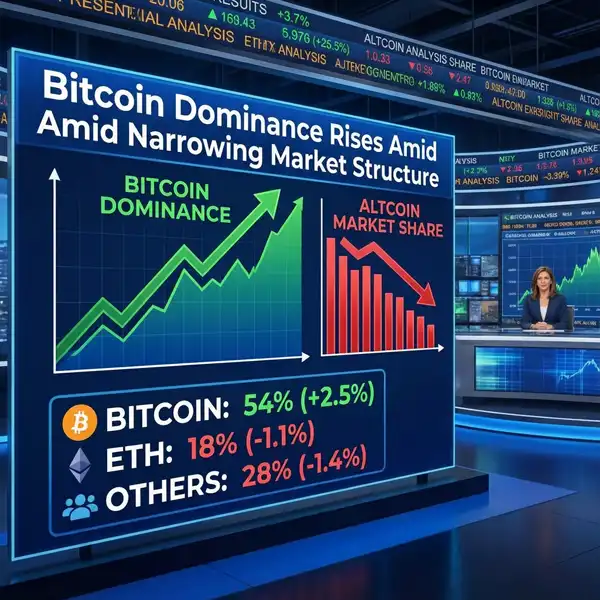
Bitcoin Dominance Rises Amid Narrowing Market Structure
Bitcoin dominance is once again climbing, signaling a notable shift in the broader cryptocurrency market structure. As capital consolidates around Bitcoin, investors and traders across the crypto ecosystem are reassessing risk, liquidity, and short-term strategy. This trend is not just a technical metric—it reflects changing market psychology and has important implications for altcoins, DeFi projects, and long-term crypto adoption.
What Is Bitcoin Dominance and Why It Matters
Bitcoin dominance refers to Bitcoin’s share of the total cryptocurrency market capitalization. When dominance rises, it typically means Bitcoin is outperforming altcoins or attracting a larger portion of new capital entering the market. Historically, periods of increasing Bitcoin dominance often coincide with uncertainty, macroeconomic pressure, or transitional market phases.
At present, Bitcoin dominance is rising amid a narrowing market structure, where price action across many altcoins has become compressed and less volatile. This combination suggests that investors are favoring perceived safety and liquidity over speculative returns, at least in the near term.
Narrowing Market Structure Signals Caution
A narrowing market structure occurs when price ranges tighten, trading volumes decline, and fewer assets lead the market. In today’s crypto environment, many altcoins are trading within constrained ranges, struggling to break key resistance levels. Meanwhile, Bitcoin continues to attract institutional interest, spot ETF inflows, and long-term holders.
This environment tends to reward assets with strong fundamentals, deep liquidity, and global recognition—advantages Bitcoin holds more than any other cryptocurrency. As a result, capital rotation favors Bitcoin while sidelining higher-risk altcoins.
Why Investors Are Rotating Back to Bitcoin
Several factors are contributing to Bitcoin’s growing dominance:
-
Macroeconomic Uncertainty
Persistent concerns around inflation, interest rates, and global economic growth have pushed investors toward assets viewed as more resilient. Bitcoin, often described as “digital gold,” benefits from this narrative. -
Institutional Participation
Increased institutional exposure through regulated investment vehicles has strengthened Bitcoin’s market position. Institutions tend to favor Bitcoin over smaller, less liquid crypto assets. -
Regulatory Pressure on Altcoins
Ongoing regulatory scrutiny in major markets has created uncertainty around many altcoins, particularly those associated with staking or complex tokenomics. Bitcoin’s decentralized and well-established status helps it stand apart. -
Liquidity Concentration
During periods of lower market-wide volume, liquidity naturally concentrates in top assets. Bitcoin’s deep order books make it the preferred choice for large traders and funds.
What This Means for Altcoins and Crypto Users
Rising Bitcoin dominance does not mean altcoins are irrelevant—but it does suggest selectivity. Historically, strong Bitcoin-led phases often precede broader market expansions. Once Bitcoin establishes a clear trend or stabilizes at higher levels, capital may rotate back into altcoins, triggering what traders call an “altseason.”
For crypto users, this is a critical period to focus on quality over hype. Projects with real-world use cases, active development, and strong communities are more likely to survive and thrive when market breadth narrows.
Strategic Opportunities in a Bitcoin-Dominant Market
For traders and long-term investors alike, a Bitcoin-dominant environment offers several opportunities:
-
Portfolio Rebalancing: Increasing Bitcoin exposure can help reduce volatility during uncertain phases.
-
Accumulation Phase: Narrowing ranges in altcoins may present long-term entry opportunities for fundamentally strong projects.
-
Market Education: Understanding dominance cycles helps users make more informed decisions instead of reacting emotionally to short-term price moves.
Looking Ahead: A Market in Transition
Bitcoin dominance rising amid a narrowing market structure suggests the crypto market is in a transitional phase—not a terminal one. While short-term speculation may slow, long-term adoption, infrastructure development, and user growth continue behind the scenes.
For crypto-focused platforms and users, staying informed during these shifts is essential. Markets reward patience, data-driven decisions, and a clear understanding of cycles. As Bitcoin strengthens its position, the broader ecosystem is quietly preparing for its next expansion.
In the evolving world of digital assets, Bitcoin’s rising dominance is not just a headline—it’s a signal. Those who understand it are better positioned to navigate what comes next.
💬 Comments (0)
No comments yet. Be the first!